
Some of the gear bought from your local pet store is perfect. Some hurt a dog in a single moment, and some of it does its damage slowly. The problem is that one item could be great for one dog but not for another, and no label will tell you it could be a danger. Toys can cause choking and blockage hazards resulting in major surgery. A chew dense enough to fracture a tooth or wear one flat can end up in a dental extraction. A collar that tightens on the neck puts force through the cervical spine and can leave lasting neck pain or flare tracheal collapse into a cough that will not settle. Prong and shock collars can cause punctures and burns where the contacts sit, and fear or aggression that outlasts whatever they were meant to train.
Memorial Villages Animal Hospital in Houston can image the throat, chest, and abdomen when something has been swallowed or a tightening collar has us worried about the airway. A tooth cracked or worn down by a dense chew needs dental X-rays under anesthesia to see the root, then treatment, which usually means taking it out with pain management while the mouth heals. Neck damage from a collar that loads the cervical spine gets treated as the pain problem it is, with medication alongside chiropractic care and acupuncture, cold laser, and rehab when the soreness keeps coming back. Whether your pet needs emergency care for a gear-related injury or you want to talk through what’s in their bin that could cause a future problem, our team is here to help.
The Gear Problems We See Most
- Swallowed toy pieces, cracked teeth, and sore necks from collars are what we treat most.
- A chew that won't flex or compress under hard pressure is harder than your dog's teeth, and a fracture that reaches the nerve almost always ends with that tooth coming out.
- Prong, choke, and shock collars can hurt the neck and skin and often make fear or aggression worse, while reward-based training gets better results without any of that.
- No single toy, chew, or harness suits every dog: your dog's build, how hard they chew, and how they behave on leash decide what's safe.
What Should I Look For When Buying a Toy or Chew?
A toy or chew that flexes under pressure is the safer buy. One you can compress or bend in your hand gives a little when your dog bears down, and one that stays rigid is harder than the enamel it's about to meet. A Veterinary Oral Health Council seal means that chew was tested and shown to slow plaque or tartar, which is a different claim from the word dental printed across a bag.
- Chews that give a little: collagen chews and rawhide alternatives flex under pressure instead of sending all of it into a tooth. Teething puppies especially need something soft on tender gums.
- Toys that stretch the chewing out: a food-stuffed rubber toy turns ten minutes of gnawing into a much longer project.
- Enrichment that skips the teeth: puzzle feeders work the brain instead of the jaw, and a snuffle mat lets a dog sniff kibble out of the fabric.
No label can guess your dog's chewing style. The right pick for a gentle 8-pound dog can be the wrong one for a Lab who finishes a chew in three bites, so ask us which chews fit your dog before you buy another one.
What Makes a Toy Dangerous for a Dog?
Trouble usually comes from toys that break into swallowable pieces, or ones hard enough to crack a tooth. Chewed-off rope strands, an exposed squeaker, a ball small enough to go down whole, and packed-together stuffing all count as gastrointestinal foreign bodies. The outcome ranges from a day of mild stomach upset to an obstruction that has to be removed surgically.
Rope worries us most in a hard chewer. Strands swallowed one at a time can gather into a linear foreign body, a long strip of material that saws at the intestine while the gut keeps trying to move it along. If you can see string or fabric hanging out of the mouth or under the tail, don't pull on it, because it may be anchored somewhere further down.
Abdominal X-rays tell us where a swallowed piece has landed, and catching it while it's still in the stomach is a much smaller problem than chasing it down the intestine. A few habits prevent most of these visits:
- Replace before it fragments: a split seam or a missing chunk means that toy is done.
- Supervise anything new: the first few sessions tell you whether your dog is a shredder or a cuddler.
- Rotate the bin: a toy that vanishes for a while comes back interesting.
- Size up: a toy should be too big to fit all the way into your dog's mouth.
What Chews Are Most Likely to Break a Tooth?
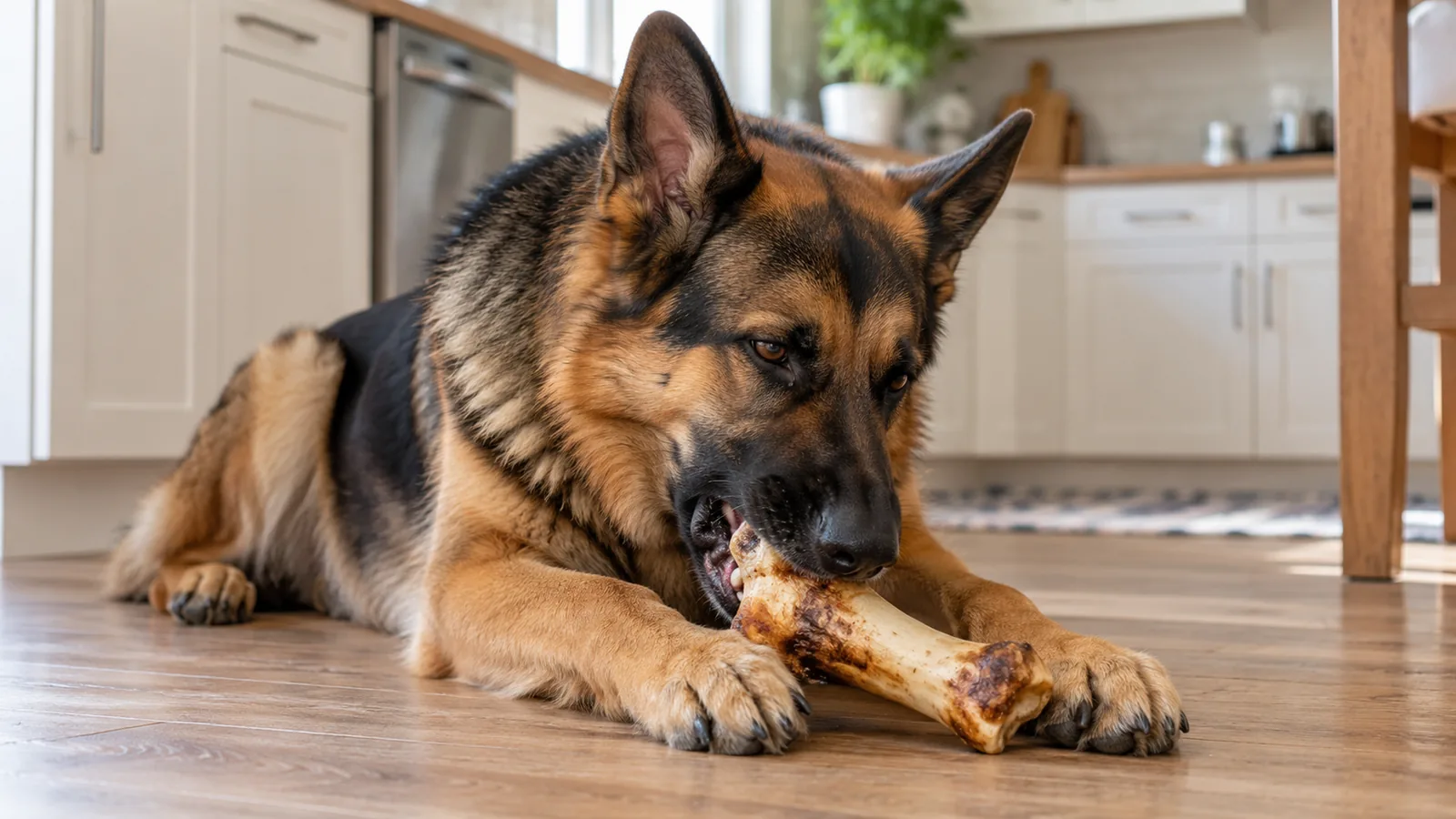
Chewing itself is healthy. The problem is hardness. Antlers, hooves, hard nylon bones, and real bones both raw and cooked are the chews that break teeth. The tooth that usually pays for it is the big upper carnassial, the large chewing tooth toward the back of the upper jaw that takes the most force every time your dog bears down.
A fracture that reaches the pulp, the living tissue inside the tooth, almost always ends in extraction. Even with no crack, years of grinding on something hard wear the tip flat and can open the pulp, letting bacteria reach the root and set up an abscess. Much of each tooth sits below the gumline, so dental X-rays separate a chip we can watch from a break that has to come out.
| Chew type | The damage it does |
| Antlers and hooves | Slab fractures of the premolars, which often go unnoticed until a dog starts favoring one side of the mouth |
| Hard nylon bones | Shatters into jagged pieces that can scrape the intestinal lining |
| Rawhide | Turns into a dense, gummy mass that can get stuck in the esophagus or intestine |
| Any chew worn down to a nub | Becomes small enough to gulp whole and choke on |
| Real bones, raw or cooked | Among the top causes of a broken carnassial tooth, and cooked bones splinter into shards |
Dogs keep eating through a broken tooth, so the signs are easy to miss:
- In the mouth: a tooth that looks darker than its neighbors, is chipped or sitting at an odd angle, or is worn flat with a dark spot in the center.
- Around the mouth: gums that bleed, drooling, pawing at the face, or breath that has turned noticeably worse.
- At the bowl: a dog who has gone off their food or chews only on one side.
Are Prong, Choke, and Shock Collars Safe to Train With?
None of the three are safe in the way the packaging implies. Marketing calls them training collars, but pain-based training collars don't teach a dog what to do instead: they interrupt a behavior with pressure or pain while the neck, the skin, and the dog's emotional state absorb the cost.
How Do Prong Collars and Choke Chains Hurt a Dog's Neck?
Each one tightens when the dog pulls, so the correction lands on one of the most delicate parts of the body. One lunge into a prong collar means pressure over the windpipe, force through the neck and spine, punctures where the points sit, and repeated pressure directly over the thyroid gland. For a dog with tracheal collapse or disc disease in the neck, a single hard pull can do real harm.
A dog who ducks away from the collar or holds their head low is showing you pain rather than stubbornness. Lingering neck soreness needs treatment rather than a tighter fit: pain management, cold laser, and rehabilitation built around how much motion the neck has lost.
Do Shock Collars Make Behavior Worse?
Shock collars, sold as e-collars or stimulation collars, often make the problem bigger rather than smaller. Aversive training methods tend to raise a dog's stress level and worsen the exact behavior they were bought to fix, because the dog connects the pain to whatever was in front of them rather than to anything they chose to do.
Contact points press against the neck and can leave burns and raw skin. The behavioral fallout is harder to undo: fear deepens around whatever the dog was looking at when the shock landed, often another dog or a stranger, and that can tip toward aggression. Worry also spreads past the original trigger, so a dog who got the collar for barking at the fence may start to dread the yard itself.
What Works Better Than a Correction Collar?
Paying your dog for the behavior you want builds habits that hold, because they're choosing it rather than dodging a correction. A prong collar suppresses pulling by making it hurt and never touches the excitement that started it, so the habit returns the moment that collar comes off. Teaching the same dog that a loose leash earns a steady trickle of small treats puts walking nicely on leash on something they want to repeat. For a dog who barks and lunges at other dogs, leash reactivity work follows the same logic. The moment your dog notices the trigger and glances back at you, hand over a treat they love. That moves the emotional response from fear toward neutral instead of muffling the bark.
What Should My Dog Wear on Walks Instead?
Gear should match your dog's build and pair with a leash that stays one length. Because head halters and harnesses put the contact point on the muzzle or the chest, nothing presses on the windpipe when your dog pulls.
- Flat collar: every dog needs one for ID tags and daily wear, but it shouldn't be the leash attachment on a dog who pulls.
- Martingale collar: for Sighthounds and other narrow-headed breeds, it tightens just enough to stop a dog slipping out, with no choking when it's sized correctly.
- Back-clip harness: comfortable for dogs who already walk calmly, with the leash clipped over the back and nothing on the windpipe.
- Front-clip harness: for dogs who pull, it turns them back toward you by steering from the chest.
- Head halter: for determined pullers, it steers the head gently, once your dog has been introduced to it slowly with treats.
A Greyhound, a Pug, and a 90-pound Lab who leans into everything don't end up in the same equipment, and behavior counts as much as body shape. Bring the harness you already own when you schedule a visit and we'll check the fit on your dog instead of guessing from a size chart.
Is a Regular Leash Better Than a Retractable One?
A fixed four to six foot leash gives the best balance of freedom and control for everyday walks. A retractable leash pays out line at the exact moment a dog pulls, which teaches the pulling. The thin cord can also cut hands and legs, leave a dog twenty feet away when something goes wrong on a busy Houston sidewalk, and snap under a big dog's lunge. A cord burn or a cut across a paw needs cleaning and a proper look, so call our emergency and urgent care before you come in.
For recall practice in an open field, a long line of fifteen to thirty feet does what a retractable claims to do, with no mechanism to jam and no reward for pulling. It's a lot of line to manage, so start somewhere with nothing to wrap around.
How Can I Tell If My Dog's Gear Is Hurting Them?
Your dog tells you in body language, usually well before a rub mark shows up on the skin. Lip licking, an out-of-nowhere yawn, whale eye (where the whites of the eyes show), and a stiff freeze as the harness goes over the head are all canine body language for discomfort. So are ducking away when the leash appears, hiding, a tail carried lower than usual, and ears pinned back.
Physical signs show up later, once something has been wrong for a while:
- Pawing or rubbing: scratching at a collar, or shoving a harness along the couch.
- Coughing on walks: a hack that starts when the leash goes tight points at the throat, so tell us about it.
- Skin changes: redness, a bald stripe, or a worn patch under the straps.
- Limping afterward: a harness that restricts the shoulder can change how a dog moves.
- Flinching when touched: soreness where equipment rests is pain, not attitude, and it needs an exam rather than a tighter buckle.
What Houston Families Ask Us About Toys and Collars
My dog swallowed part of a toy but seems completely fine. Should I still call?
Give us a call either way. A dog can look perfectly normal for hours or even days with something sitting in the stomach, and those first hours are the easiest window to deal with it. Never make your dog vomit at home unless we tell you to, because some objects do more damage coming back up. Tell us what it was, roughly how big, and when it happened, and we'll say whether to come in now or watch at home.
Are tennis balls safe for fetch?
Fetch is fine in moderation. The felt surface is abrasive enough to grind enamel down over years of hard chewing, so a tennis ball is something to throw rather than something to leave out for gnawing. A standard ball can lodge in a large dog's throat, so big dogs need a bigger ball, and any ball that's been split open should go in the trash.
My puppy's collar fits now. How often should I check it?
Check it every few weeks while they're growing, and more often during a growth spurt, when a collar can go from roomy to snug surprisingly fast. You should be able to slide two fingers under it comfortably. A flat collar is for ID tags, so if your puppy is already pulling on walks, clip the leash to a harness instead and keep that pressure on the chest rather than the neck.
Picking Safe Gear for Your Dog
Bring the toy, the chew, or the harness to your next appointment at Memorial Villages Animal Hospital in Houston and we'll tell you what we'd keep and what we'd swap for your dog's size and chewing style. If something has already gone wrong, like a swallowed piece, a cracked tooth, or a cough that started on the leash, reach out and we'll get your dog in.